
AI Finally Makes Sense When You See This
AI Finally Makes Sense When You See This
The tools are already here. The barrier is just knowing which layer you need.
A few weeks ago, I was talking to a business owner who has run a successful company for 15 years. Smart guy. Great instincts. But when AI came up, he shut down. "I don't have time to learn to code," he said. "That's not what I do." He reminded me of myself in the early 2000s. I remember sitting in front of HTML and CSS files thinking I should probably understand how websites worked. But I had a job. I had real work to do. Tinkering with code felt like something other people did. People who had time for that sort of thing.
Sometimes I wonder where I'd be if I really dug into those tools back then. But, the reality was that it took A LOT to be a professional developer, or at least at the caliber I would expect of myself. But, the important point is that I still became aware of the technology. I didn't know how to build it but I embraced it. If you were in the workforce back then you probably did too. You certainly do now.
AI feels like that moment again. But there's something different this time.
AI is more disruptive than technologies that came after the internet like video conferencing or cloud storage. If we're being honest, this moment is closer to the scale of the internet itself. But unlike the internet in 1998, AI is accessible. You don't need to learn HTML to use AI like a pro. You don't need to figure out hosting or domain registration or FTP clients. You just ask it a question. And if you're not sure how to ask, the AI will tell you how to use it.
That's the wild part. The most disruptive technology in decades is also the most accessible we've ever had. And yet, people are sitting it out for the same reason I almost did 25 years ago. They think they need to become something they're not.
The Problem when people "talk about" AI Today
It seems that most conversations about AI fall into one of two camps. Either someone is trying to convince you that AI will replace your job, or they're selling you a course that promises to turn you into a prompt engineer in 30 days. Both miss the point.
AI is a tool. Like Excel. Like email. Like your CRM. You don't need to understand how Excel calculates a VLOOKUP to use it for your business. You just need to know it exists, what it does, and which version fits your needs. The same applies to AI.
But unlike Excel, the AI landscape feels overwhelming because no one bothered to draw you a simple map. So I made one.
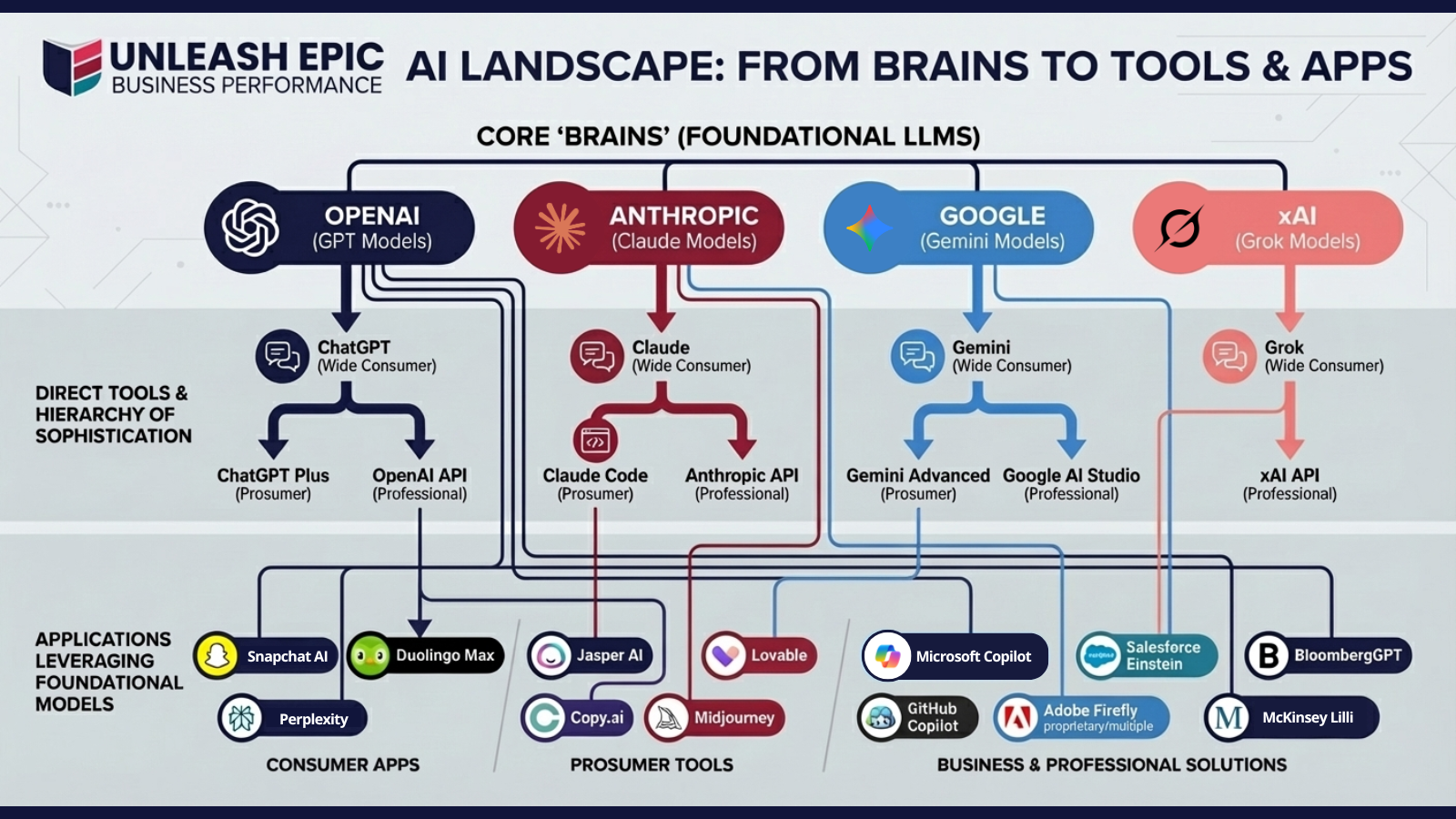 Spoiler: This was built with Nano Banana Pro by Google/Gemini. There may be errors. For conceptual understanding only.
The AI Landscape: Brains, Tools, and Apps
Look at the infographic above. It shows the entire AI ecosystem in three layers. Once you see it laid out like this, it stops feeling complicated.
Layer 1: The Brains (Foundation Models)
At the top, you have the core "brains" of AI. These are the foundational large language models (LLMs) built by four major companies:
These are the engines. You don't build them. You don't need to understand how they work. You just need to know they exist and that every AI tool you use is probably powered by one of these four.
Most people never think about this layer. And that's fine. You're not here to build foundational models. You're here to use what they make possible.
Layer 2: Direct Tools (How You Access the Brains)
The second layer is where most people actually interact with AI. These are the consumer-facing tools and professional APIs provided by the companies that provide the models. They let you tap directly into their foundational models.
Wide Consumer Tools:These are free or low-cost. You type a question, you get an answer. If you've used ChatGPT, you've already used AI. That's it. You're in.
Prosumer and Professional Tools:If you're a business owner who wants custom solutions, this is where you'd start. You don't need to build these tools. You use them to build something that helps you or your team specifically, or hire someone who knows how to connect them to your workflows.
Layer 3: Applications (Tools Built on the Brains)
This is where it gets practical. These are the apps and platforms you already use or have heard of. They're all powered by the foundational models, but they're built for specific use cases.
Consumer Apps:You don't need to use all of these. You don't even need to use most of them. You just need to know they exist so that when someone mentions one, you understand where it fits.
The Part Most People Miss
Here's what changed in the past 18 months that most business professionals don't realize yet. You can build custom AI solutions for your business without hiring a development team or spending six months in production. This is not like building your own Salesforce. This is more like the elegant Excel macro a savvy VP built to automate their monthly reporting. Or the Access database someone created in the early 2000s that became essential to how an entire department operated (or possibly still does 👀).
Except now, instead of learning VBA or SQL, you can describe what you need and AI helps you build it. In days, not months.
I've seen operations leaders build tools that pull data from three systems, analyze it against benchmarks, and generate executive briefings. All custom. All tailored to exactly what their team needed. Not a template. Not a one-size-fits-all solution some vendor sold them.
That's what the professional layer unlocks. Not just using ChatGPT to write better emails. Actually building tools that solve problems unique to your business. The kind of problems you've always known how to solve manually, but never had the resources to automate.
And the people who understand this earliest, the ones who can pair their process knowledge with these tools, are solving problems others are still paying consultants $200K to fix.
What About Security and Data Privacy?
This is where business professionals need to pay attention. When you build custom solutions using the professional APIs, you control your data in ways you don't with consumer apps.
API-based tools work differently than ChatGPT Free or Pro. When you connect directly through the API, your data isn't used to train the models. OpenAI, Anthropic, Google, and xAI all have policies that business API data stays with you. It's encrypted in transit and at rest. Think of it like your company's servers sitting on AWS. You own the data. The AI provider just processes it and hands it back.
For small and mid-sized businesses cleared to use AI, this is your green light. You can build custom tools that handle your proprietary processes without worrying about your competitive advantage leaking into someone else's model.
For enterprise users, especially those handling customer data or operating under compliance requirements like HIPAA or SOC 2, you'll need to work with your IT or Legal teams. The major providers all offer enterprise agreements with additional controls, data residency options, and audit trails. It's not a blocker. It's just a conversation you need to have with the right people in your organization.
The point is this. Data privacy isn't a reason to sit on the sidelines anymore. It's a feature of how these tools work when you use them correctly.
Where Do You Actually Fit?
Here's the part that matters. You don't need to be at the top of this map to use AI effectively. Most business professionals sit somewhere in the middle. You're using ChatGPT or Claude to draft emails, summarize documents, or brainstorm ideas. Maybe you've tried Jasper or Copy.ai for content. Maybe you're exploring Microsoft Copilot because it's already in your Office suite.
That's enough. You're not trying to build the next AI startup. You're trying to run your business faster, with less friction, using tools that are already available to you.
The map just shows you what's possible. It removes the fear that you're missing something or that you need a computer science degree to keep up.
What This Means for You
If you're reading this and you've been avoiding AI because it felt too big or too technical, here's what I want you to take away:
You're already closer than you think. If you've used ChatGPT, you've used AI. If you've tried Grammarly or asked Siri a question, you've used AI.
The tools are accessible. The barrier isn't technical. It's just understanding where you fit. And now you can see the map.
You don't need to learn to code. You don't need to become a prompt engineer. You just need to pick one tool that solves a problem you have today and start using it.
But if you're thinking bigger, if you're starting to see problems in your business that could be solved with custom tools, that's where things get interesting. Because the gap between "I see the problem" and "I built the solution" is smaller than it's ever been.
The Invitation
Starting January 1, I'm building those tools in public. Not theoretical frameworks. Actual working solutions that combine business process knowledge with accessible AI. Tools that help experienced professionals find the right clients. Tools that turn discovery calls into custom proposals in 48 hours. Tools that automate the parts of consulting that used to take weeks.
I'm doing this because I spent two years solving problems that were outside of my "zone of genius", and I finally figured out who I'm built to serve. People who understand how business actually works. People who've navigated enough complexity to know what's broken. People who don't need me to teach them process, just help them build faster.
If you want to see how this works in practice, follow along. I'll show you the exact tools I use, the workflows I build, and the mistakes I make along the way. Not because I'm an AI expert. Because I'm a business professional who learned to use what's available.
And if at some point you think, "I could use something like that for my business," reach out. That's exactly the kind of conversation I'm looking for.
Get notified when I publish new guides
Practical insights on building production apps with AI. No spam, just substance.
No spam. Unsubscribe anytime.

John Vyhlidal
Founder & Principal Consultant
Air Force, PwC, Nike. 20+ years building systems that turn strategy into results. Now helping mid-market executives navigate complexity.